.jpg)
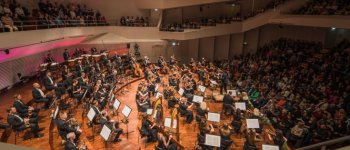
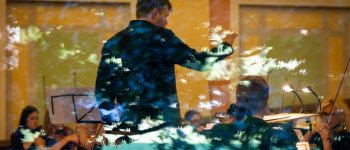
On November 7, the Liepāja Symphony Orchestra and internationally acclaimed Latvian cellist Margarita Balanas invite the audience to the “Lielais dzintars” concert hall for an evening featuring the intertwined musical styles of three early 20th-century British composers. British maestro Douglas Bostock will take the conductor's podium.
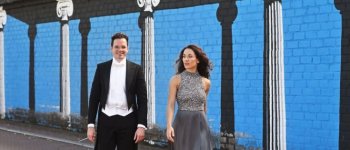
At the heart of the concert program lies the work of one of England’s most distinguished composers, Edward Elgar—specifically, his Cello Concerto. This piece stands as a central work from the composer’s late period and ranks among the most significant compositions in the cello repertoire. Joining the Liepāja Symphony Orchestra on stage to perform the concerto will be Margarita Balanas, a musician described by critics as one of the most brilliant cellists of her generation.
“Elgar’s Cello Concerto demands from the soloist deep inner concentration, the ability to maintain dramatic tension and a personally open, grotesque expression. In my opinion, Margarita Balana’s playing possesses the dramatic power and intensity necessary for this work. Her interpretations always convey a rich timbral imagination, poetry and the ability to give meaning to each motif,” comments Guntis Kuzma, artistic director of the Liepāja Symphony Orchestra. “Being also a conductor, Margarita creates the solo part as a living conversation with the orchestra. I am looking forward with great interest to how the nobility, lyricism and human warmth of this concerto will be revealed in her interpretation.”
Under the direction of Maestro Douglas Bostock, the Liepāja Symphony Orchestra will also perform Ralph Vaughan Williams’s London Symphony. It is one of the most significant British symphonic works from the early 20th century, marking the composer’s transition from a national-romantic style to a broader symphonic approach.
The symphony—in which elements of London can be heard, such as the the tolling motifs of Westminster bells, echoes of street musicians, and the city’s rhythmic tension—holds a special place in British music history not only for its expansive form, but also for its aesthetic programme: in it Vaughan Williams affirms the belief that national identity in music may be expressed not only through the direct use of folk-music quotations, but also through harmonic thinking and the shaping of musical time itself.
Meanwhile, the Phantastes Suite by Gustav Holst—whose family roots, incidentally, are also linked to Riga—will be heard by an audience in Liepāja for the first time since its premiere way back in 1912. As conductor Douglas Bostock notes, after this single performance Holst withdrew the piece and removed it from his official catalogue of works, considering it an artistically incomplete realization of his idea. As a result, the Phantastes Suite has remained outside the concert repertoire, unlike other works from the same period that later became established in the canon.
The suite reveals Holst as a composer in a period of artistic exploration: it brings together vivid symphonic colours, rhythmic vitality, and an experimental form, foreshadowing ideas that would later develop in more mature works. In this way, it offers valuable insight into the formation of the composer’s musical language and provides a rare opportunity to encounter a lesser-known yet significant page in British symphonic music.
Internationally acclaimed conductor and educator Douglas Bostock—known for his refined sense of interpretation, balanced orchestral sound, and passion for breathing new life into classical music—is distinguished by several unique qualities in his artistic work; one of these is his dedication to uncovering lesser-known and forgotten repertoire.
Tickets for the Liepāja Symphony Orchestra concerts can be purchased at “Biļešu paradīze” ticket offices.
The concert is supported by the Ministry of Culture of the Republic of Latvia and Liepāja city.